
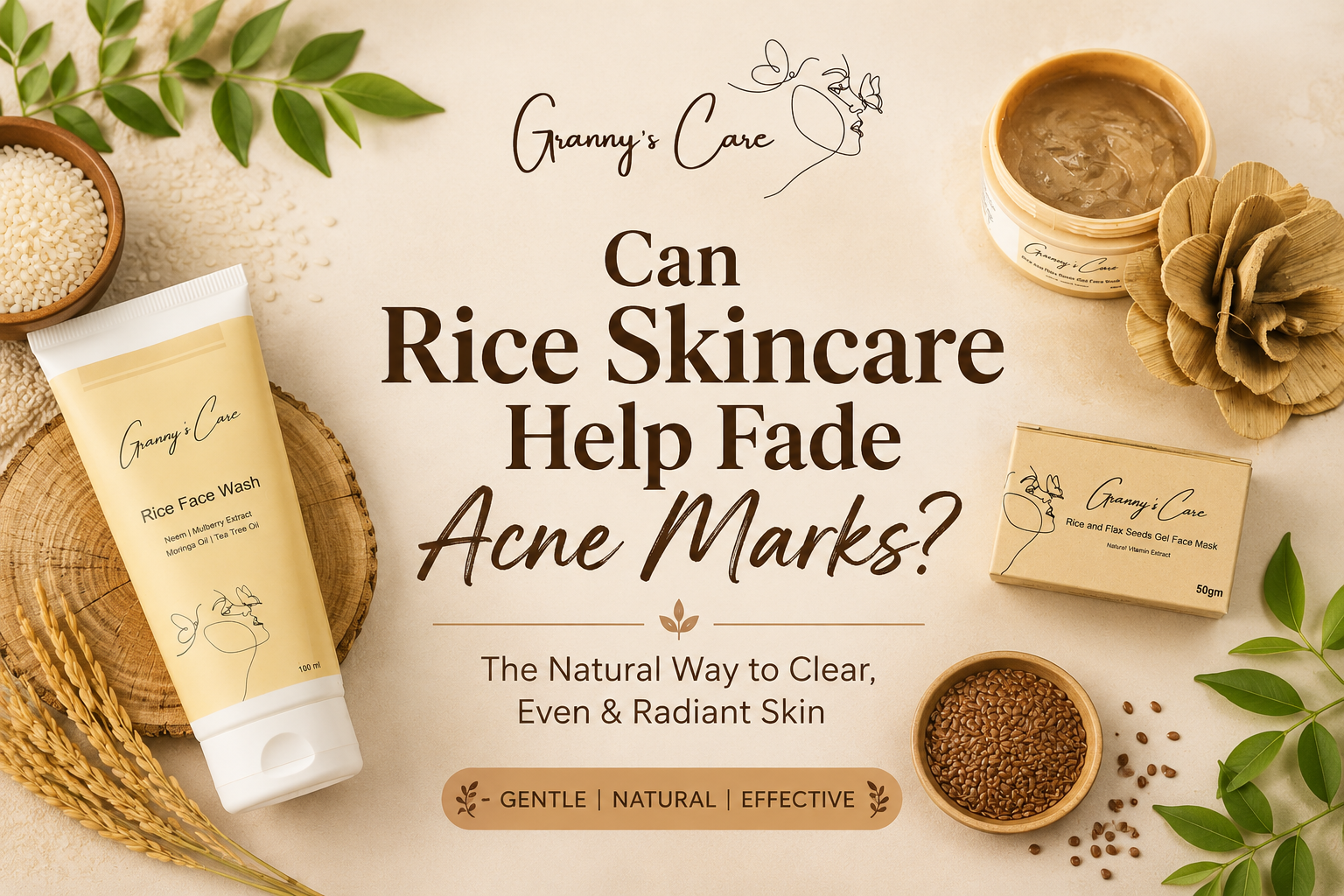
Rice skincare for acne marks has become a popular natural solution for people looking to fade stubborn post-acne spots. Let’s be honest about something first. If you’ve ever sat in front of a mirror, pressed a finger against an old acne spot, and silently begged it to just go away already, you’re not alone. Acne itself is annoying, but the marks it leaves behind? Those feel almost worse. They overstay their welcome. They show up in photos. And they make you reach for concealer on days you’d rather just wear your bare face.
Thank you for reading this post, don't forget to subscribe!So when people ask us whether rice skincare for acne marks can actually make a difference, we get it. You don’t want another miracle promise you want the truth. Here’s the honest version: yes, rice can help. But let’s talk about how, how much, and what it realistically can and can’t do. Because at Granny’s Care, we’d rather tell you the real story than sell you a fairy tale.
What Is Rice Skincare for Acne Marks and How Does It Help?
This part matters more than people think.
What most of us call “acne scars” are usually not scars at all. They’re marks flat patches of discoloration left behind after a pimple heals. There are two common kinds: The brown or dark spots are what doctors call post-inflammatory hyperpigmentation. This is your skin going a little overboard with melanin while it heals. It’s extremely common on Indian and brown skin tones, and it’s the type that natural skin lightening products like rice can genuinely help with. The red or pink marks are a different thing that’s leftover inflammation and tiny blood vessels showing through while the skin recovers. Both of these fade. Slowly, sometimes maddeningly slowly, but they fade.
What does not simply fade are true scars those little pitted dents in the skin (the ones people call icepick or boxcar scars). Those are changes in the skin’s actual texture, and no face pack on earth, ours included, is going to fill those in. That’s honest-shopkeeper talk. For deep textural scarring, you’d be looking at a dermatologist and treatments like microneedling or peels. So when we talk about rice helping, we’re talking about those flat brown and red marks which, happily, are exactly what most people are dealing with.
Why our grandmothers were onto something with rice
If you grew up in an Indian household, there’s a decent chance you saw rice water being saved, not thrown out. Nani would rinse the rice, keep that cloudy water, and use it on her hair or skin. It wasn’t a trend. It was just… what you did. Turns out the science quietly agrees with her. This is exactly why natural products for skin have made such a strong comeback people are realising the simple stuff often works. Rice is rich in a handful of things that are genuinely useful for fading marks:
Ferulic acid and allantoin help calm down irritated skin and support healing. When your skin is less inflamed, marks settle faster and don’t linger as long.
Niacin and antioxidants gently interfere with that excess melanin production the same melanin responsible for those stubborn dark spots. Over time, this helps the spots lighten, which is what makes rice such a gentle natural product for skin care routines.
Amino acids and vitamin E support your skin barrier, which is basically the foundation for skin that heals well and stays calm.
None of this is dramatic overnight magic. It’s the slow, steady, let-your-skin-do-its-job-better kind of help. Which, honestly, is what most skin actually needs.
Don’t sleep on flax seed either
While we’re talking grandmother wisdom, flax seed deserves a mention right next to rice. If you’ve never tried flax seed gel for face care, you’re missing out on one of the simplest, most underrated natural ingredients out there. Flax seed gel for skin is packed with omega-3s and a natural soothing quality that pairs beautifully with rice. Where rice works on tone and brightness, flax seed gel on face helps with hydration, calming redness, and that soft, bouncy feel your skin gets when it’s properly nourished. Using flax seed gel for skin alongside rice-based care gives your skin a fuller routine one targets the marks, the other keeps the skin barrier happy and healthy. It’s a good reminder that the best natural skincare products usually work together, not alone.
So how does rice skincare actually help fade the marks?
Think of it less like an eraser and more like a helping hand. Your skin already wants to fade those marks on its own. Rice-based skincare supports that process, calming inflammation, gently discouraging extra pigment, and keeping the skin healthy enough to recover properly. Used consistently, it can help the whole thing move along faster and look more even. This is why we built our range around exactly this idea the Rice Face Wash for daily gentle cleansing, the Rice Radiance Face Pack for that weekly brightening boost, and our flaxseed face mask when your skin needs extra calm and hydration. The idea isn’t to shock your skin. It’s to feed it the kind of gentle, natural goodness it actually responds well to, the way Dadi and Nani always intended. And the convenience of buying online skin care products today means you don’t have to hunt through markets for these ingredients, you can get the natural products for skin you need delivered to your door.
The honest part nobody likes to hear
Here’s where we put on our serious face for a second. Rice skincare products help but it is not a substitute for the single most important thing you can do for acne marks: sunscreen. We’re not exaggerating. Sun exposure is the number one reason marks darken and stick around longer than they should. You can use the most beautiful rice face pack or the best natural skin lightening products every single day, but if you skip sunscreen, you’re basically filling a bucket with a hole in the bottom. Apply SPF every morning. That one habit will do more for your marks than almost anything else. The second honest thing: be patient. Real fading happens over weeks and months, not days. Anyone promising to erase your marks in a week is, well… let’s just say they’re not your grandmother.
A simple, realistic routine
If you want to give rice a fair shot, keep it gentle and consistent: In the morning, cleanse with a mild rice face wash, follow with a light moisturizer, and then non-negotiable sunscreen. Two or three times a week, treat your skin to a rice face pack, and on the days it needs soothing, reach for flax seed gel for face hydration. At night, cleanse off the day and moisturize. That’s it. No twelve-step madness. Just steady care with good natural skincare products. If your marks are very deep, very old, or genuinely textured rather than flat, please see a dermatologist. There’s no shame in that sometimes skin needs a professional, and natural care works beautifully alongside that, not against it.
The bottom line
Can rice skincare help fade acne marks? Yes for the flat brown and red marks most of us actually have, rice is a gentle, time-tested helper that calms the skin, eases pigmentation, and supports your skin’s own healing. Pair it with flaxseed gel for skin, daily sunscreen, and a little patience, and you’ve got a genuinely effective, fully natural skin care product that nudges your skin toward looking clearer and more even.
It won’t perform miracles overnight, and it won’t fix true pitted scars. But sometimes the old wisdom really did know best. Rice happens to be one of those things our grandmothers got right long before science caught up.